Introduction - (Part 2)
For Part 1 - Read Here
I have been diagnosing many patients from Hetauda, Kathmandu, Biratnagar, Pokhara, Janakpur, Simra, Kalaiya, Gaur, Butwal, Patan, Bhadrapur and lot of other places near Birgunj — and one pattern is clear: fungal skin infections (dermatophyte infections and pityriasis) are consistently common across these regions.
This post explains why these infections are widespread, presents a clear clinical example that occurs across Hetauda, Kathmandu, Biratnagar, Pokhara, Simra, Kalaiya, and other towns near Birgunj, and describes how Dr Rohit Gupta diagnoses, treats, and prevents them. The article is written from a professional dermatology perspective, provides practical tips and actionable advice, and is optimized to increase organic reach for patients in the targeted areas.
Why fungal skin infections are common across Nepalese cities
Fungal skin infections — including dermatophyte infections (tinea corporis, tinea cruris, tinea pedis) and pityriasis versicolor — are among the most prevalent dermatoses in Nepal and similar South Asian settings because of climatic, social, and behavioral factors.
- Climate and seasonality: Warm, humid conditions (especially during monsoon) favor fungal growth on skin and clothing and increase disease incidence.
- Living conditions: Crowded housing, poor ventilation, and prolonged damp clothing or footwear increase transmission and recurrence.
- Occupational exposure: Agricultural and outdoor work increases sweating and microtrauma to skin, facilitating fungal invasion.
- Limited early treatment: Delayed or incomplete treatment allows spread within households and communities.
Population studies from Nepalese and nearby Himalayan regions report high prevalence of superficial fungal infections as a leading cause of outpatient dermatology visits, supporting the clinical pattern seen in patients from Hetauda, Kathmandu, Biratnagar, Pokhara, Simra, Kalaiya and places near Birgunj[1][3].
Typical presentation: one common example across the regions
We will use tinea corporis (ringworm) as a representative example because it is common, recognizable, and managed similarly across urban and rural settings in Nepal.
Clinical features
- Itchy, erythematous, expanding round or annular plaques with central clearing and active scaly border.
- May affect trunk, limbs, groin (tinea cruris) or feet (tinea pedis) depending on exposure and habits.
- Often transmitted via shared towels, clothing, mats, or direct contact with infected persons or animals.
Why it appears in Hetauda, Kathmandu, Biratnagar, Pokhara, Simra, Kalaiya and nearby areas
The same behavioral and environmental drivers — crowded homes, humidity, wearing occlusive footwear, and delayed care — explain the uniform presence of tinea across Hetauda, Kathmandu, Biratnagar, Pokhara, Simra, Kalaiya, mentioned lot of other places near Birgunj, take one common example of skin diseases which is same across all in my clinical practice.
How Dr Rohit Gupta approaches diagnosis
Dr Rohit Gupta uses a stepwise, evidence-based approach combining clinical assessment with targeted investigations when needed:
- History and examination: Onset, spread, exposure to affected contacts or animals, symptom pattern, prior treatments, and local factors (occupation, footwear, bathing habits).
- Typical bedside tests: Potassium hydroxide (KOH) microscopy of skin scrapings to identify fungal hyphae when diagnosis is uncertain.
- When to culture or refer: For recurrent, widespread, atypical, or treatment-resistant cases, Dr Gupta arranges fungal culture or referral for patch testing if differential includes eczema or contact dermatitis.
This structured approach ensures accurate diagnosis rather than empiric long-term steroid use, which can worsen fungal infections.
Treatment strategy used by Dr Rohit Gupta
Treatment is tailored by severity, site, and patient factors (age, pregnancy, comorbidities, drug interactions). Key components of Dr Gupta’s protocol include:
- Topical antifungals (first-line for limited tinea corporis/tinea cruris): azoles (clotrimazole, miconazole) or allylamines (terbinafine) applied for 2–4 weeks depending on response.
- Oral antifungals (for extensive, chronic, or nail/scale-bearing disease): oral terbinafine or itraconazole with appropriate dosing and liver monitoring when indicated.
- Adjunctive measures: antipruritic emollients, short-term antiseptic washes for secondary bacterial infection, and strict avoidance of topical corticosteroids unless specifically indicated.
- Household management: simultaneous treatment or screening of household contacts, laundering clothes and bedding in hot water, and advising against sharing towels or slippers.
- Follow-up plan: scheduled reassessment to confirm clinical clearance and to decide duration of treatment (to reduce recurrences).
Dr Rohit Gupta emphasizes safe prescribing and patient education to prevent incomplete courses and inappropriate steroid use which are common causes of treatment failure.
Prevention and community measures — practical tips for patients from Hetauda to Pokhara
Prevention reduces recurrence and transmission. Dr Gupta gives clear, actionable advice that is feasible for patients from Hetauda, Kathmandu, Biratnagar, Pokhara, Simra, Kalaiya, and places near Birgunj:
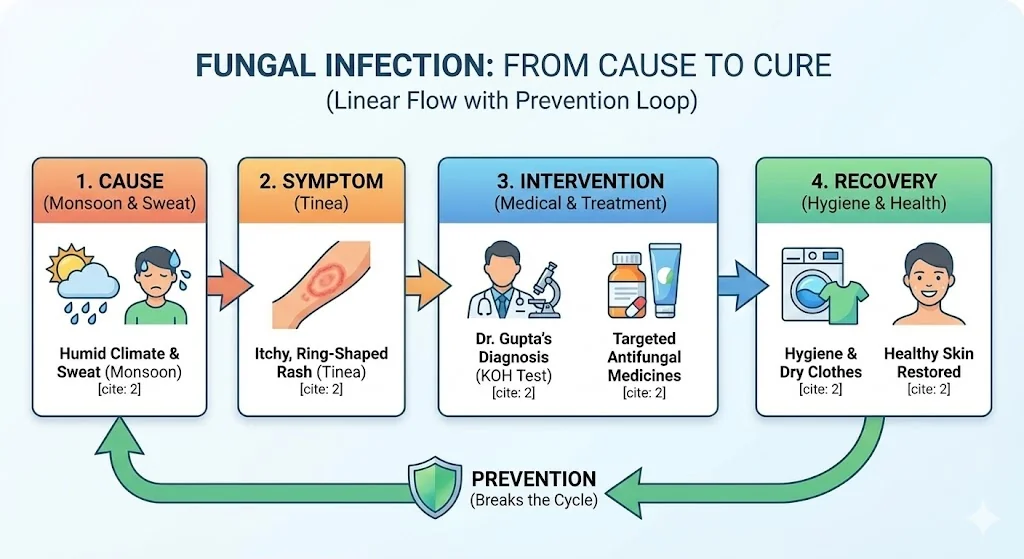
created by Dr. Rohit Gupta, Nepal
- Personal hygiene: daily drying of skin folds after bathing, using breathable cotton clothing, and changing socks daily.
- Footwear and clothing care: wear well-ventilated footwear; rotate shoes to allow drying; wash and sun-dry clothes and footwear where possible.
- Household steps: wash shared towels and bed linen in hot water; avoid sharing personal items; disinfect mats, sleeping surfaces, and frequently touched fabrics.
- Environmental tips: improve ventilation at home to reduce humidity; repair leaking roofs and walls to reduce dampness; sunlight exposure for bedding and clothing helps kill spores.
- When to seek care: persistent, spreading, painful, or extremely itchy lesions; involvement of scalp, nails, groin with severe symptoms; or failure of initial topical therapy after 2–4 weeks should prompt medical review.
Patient education: what Dr Rohit Gupta tells his patients
Effective communication improves adherence. Dr Gupta emphasizes:
- Complete the prescribed course: Stop intermittent or shortened therapies that can cause relapse.
- Avoid steroid creams: Over-the-counter steroid-antifungal combinations can mask symptoms but worsen fungal growth.
- Family screening: Treat or check household members to prevent reinfection cycles.
- Follow-up: Return for review if symptoms persist or new lesions appear even after finishing treatment.
Real-life examples and outcomes
Example 1 — Young farmer from Simra: presented with multiple annular plaques on arms and trunk after months of working in humid fields. Dr Gupta confirmed tinea corporis by KOH, prescribed topical terbinafine and a 2-week course of oral therapy because of extent, advised on clothing hygiene and treating family contacts; lesions resolved by 6 weeks with no recurrence at 3 months.
Example 2 — Office worker from Kathmandu: athlete’s foot (tinea pedis) with secondary bacterial fissures. Dr Gupta used topical allylamine, antiseptic soaks, footwear advice, and short oral antibiotic for secondary infection; patient improved and avoided chronic recurrence with preventive measures.
These case examples are illustrative of the consistent approach Dr Rohit Gupta applies across patients from Hetauda, Kathmandu, Biratnagar, Pokhara, Simra, Kalaiya, and other towns near Birgunj.
Addressing common misconceptions
- "All red scaly rashes are fungal": Not always — eczema, psoriasis, and contact dermatitis can mimic tinea; simple bedside tests or trial treatments help avoid misdiagnosis.
- "Steroid creams cure everything": Topical steroids can temporarily reduce inflammation but worsen fungal growth and cause atypical presentations (tinea incognito).
- "Home remedies suffice": Some supportive measures (drying, sunlight) help but established antifungal therapy is often necessary for cure.
Call to action — what patients should do next
If you live in Hetauda, Kathmandu, Biratnagar, Pokhara, Simra, Kalaiya, or places near Birgunj and suspect a fungal skin infection or recurrent rash, schedule an evaluation with Dr Rohit Gupta for diagnosis, KOH testing when indicated, evidence-based treatment, and practical prevention advice tailored to your living conditions.
Make sure to bring details about symptom duration, household contacts with similar problems, prior treatments used (especially topical steroids), and occupation or activities that increase sweat exposure.
Final practical checklist (quick reference)
- Dry skin thoroughly after bathing; avoid prolonged damp clothing.
- Use topical antifungal cream as prescribed for full duration.
- Wash towels and bedding regularly in hot water and sun-dry.
- Treat household contacts or have them screened.
- Avoid over-the-counter steroid combinations without doctor’s advice.
- Return for follow-up if no improvement after 2–4 weeks or if lesions spread.
Dr Rohit Gupta combines clinical evidence, targeted investigations, patient education, and community-focused prevention to manage the common fungal skin problems that affect patients across Hetauda, Kathmandu, Biratnagar, Pokhara, Simra, Kalaiya, and other towns near Birgunj — reducing symptoms, preventing recurrence, and improving quality of life.