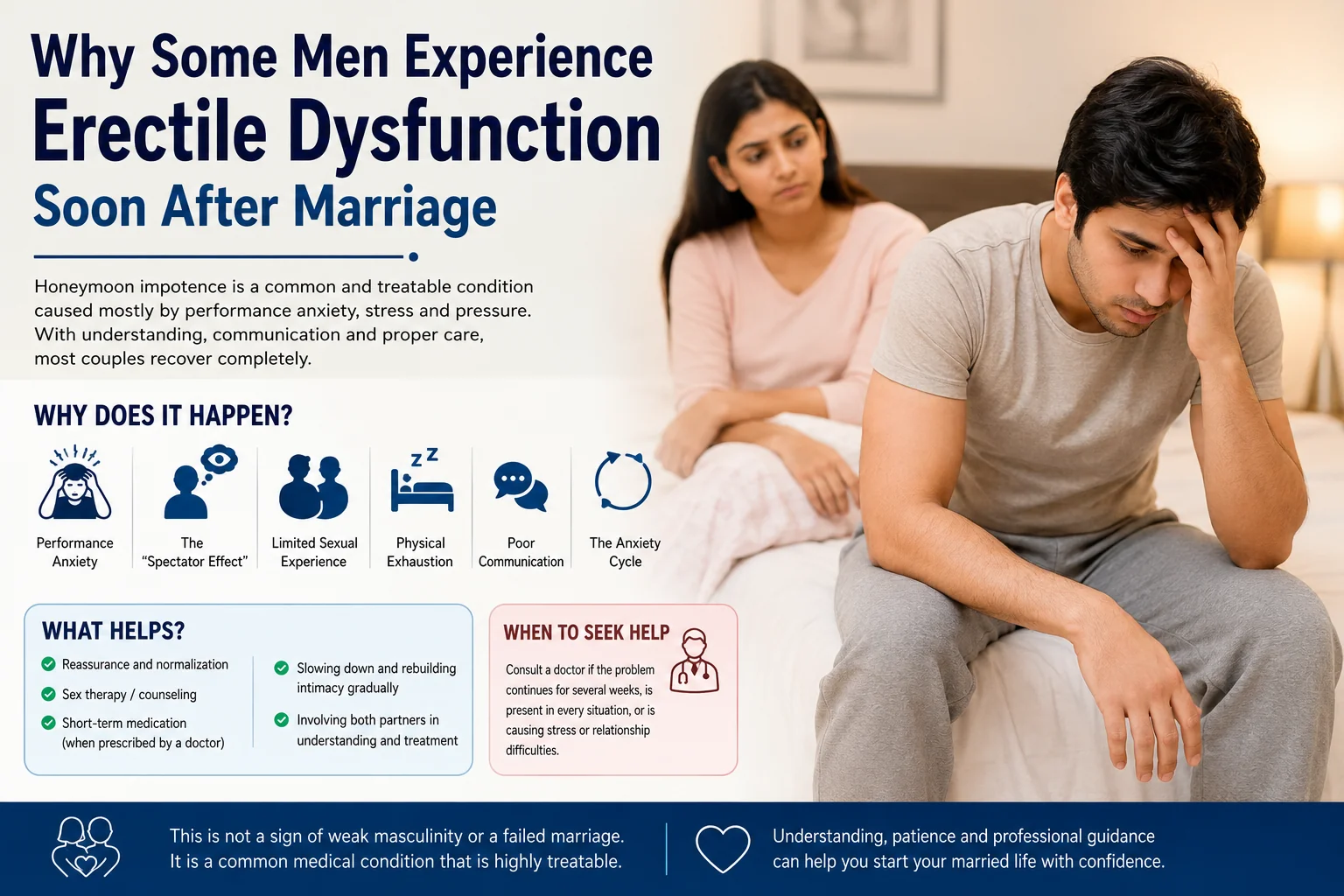
It's one of the more common — and more quietly distressing — presentations in a venereology or urology clinic: a newly married man, sometimes accompanied by his wife, describing an inability to achieve or maintain an erection during the first days or weeks of marriage. In clinical literature this is often called honeymoon impotence, and it's far more common, and far more treatable, than most couples realize.
What Is Honeymoon Impotence?
Honeymoon impotence is defined as the failure to successfully complete sexual intercourse at the beginning of marriage, particularly during the first few nights. It's not a distinct disease so much as a specific presentation of erectile dysfunction tied to a very particular emotional and social context — the wedding night, the honeymoon period, and the pressures that surround it.
Importantly, this isn't rare or unusual. Multinational studies have found that erectile dysfunction affects up to 30% of men under 40, and in young men without cardiovascular risk factors, psychogenic causes are generally the main driver rather than physical disease.
Why Does It Happen?
The overwhelming majority of these cases are psychogenic rather than organic — meaning the erectile mechanism itself works fine, but the mind is interfering with it.
1. Performance anxiety :
Stress due to high expectations and pressure to perform well during such an emotionally significant moment can with sexual function. When the body is under intense anxiety, blood flow to the penis — which is essential for an erection — decreases, and erection difficulties follow.
2. The "spectator role" :Classic sexual medicine research describes how performance anxiety causes a man to mentally step outside the moment and monitor his own performance, pulling his attention away from arousal itself.Instead of responding to erotic cues, the mind fixates on "is it working," which paradoxically makes it less likely to work.
3. Unfamiliarity and inexperience This is especially relevant in cultures — including much of South Asia — where arranged marriages are common and premarital sexual experience is limited or absent. In more conservative societies, couples often have limited premarital sexual experience, and the resulting stress can itself interfere with the ability to achieve an erection, sometimes leading to an unconsummated marriage.
4. Fatigue and circumstance : The physical exhaustation due to wedding events, travel, alcohol, and the general excitement of a life time events can also affect sexual function.
5. Communication gaps : A lack of open conversation between both partner about expectations and needs can add further enhance misunderstanding and anxiety on top of an already stressful situation.
6. The self-perpetuating cycle . After one failed attempt, many men feel compelled to "fix" the problem immediately and try again under even more pressure — which often produces the same result and deepens the anxiety further. This spiral is often what turns a one-off bad night into weeks of unconsummated marriage and mounting distress for both partners.
Is It Ever Physical?
Sometimes — and this is why proper evaluation matters rather than assuming it's "all in the head." Research on honeymoon impotence has found that roughly 28% of affected men have an underlying physical cause rather than performance anxiety alone. A good clinical work-up typically includes a detailed history, a validated questionnaire like the IIEF-5, and — where indicated — tests to rule out vascular or hormonal contributors before concluding the cause is purely psychological.
What Actually Helps
The good news is that this condition responds well to treatment, and it's rarely a sign of any lasting problem in the marriage or the man's health.
- Reassurance and normalization. Simply learning that this is common, well-documented, and usually temporary reduces a significant share of the anxiety driving it.
- Sex therapy / counseling. Addressing performance anxiety directly, often together with the partner, breaks the "spectator role" cycle described above.
- Short-term medication. Clinical management often combines short-term use of PDE5 inhibitors like sildenafil together with sex therapy for men with psychogenic ED in this setting.In cases where oral medication alone doesn't work, brief use of low-dose injectable therapy has also been shown to be safe and effective at breaking the cycle, after which many men resume normal erections without needing ongoing treatment.
- Slowing down. Removing the pressure of "achieving intercourse tonight" and reintroducing physical intimacy gradually — without a performance goal attached — is often the single most effective intervention.
- Couple-centered approach. Since the anxiety is often relational as much as individual, involving the partner in understanding and treatment tends to produce better and faster outcomes than treating the man in isolation.
The Clinical Takeaway
For clinicians, the key is to avoid two opposite mistakes: dismissing it as "just nerves, it'll pass" without any evaluation, and over-medicalizing a normal, common adjustment reaction with unnecessary tests or long-term medication. A brief history, a validated symptom scale, basic screening to rule out organic causes when indicated, and honest reassurance go a long way — often resolving the issue within a few sessions or a few weeks.
For patients, the most important message is simple: this is common, it has a name, it's well studied, and it is very treatable. It is not a verdict on the marriage, on masculinity, or on future sexual health.